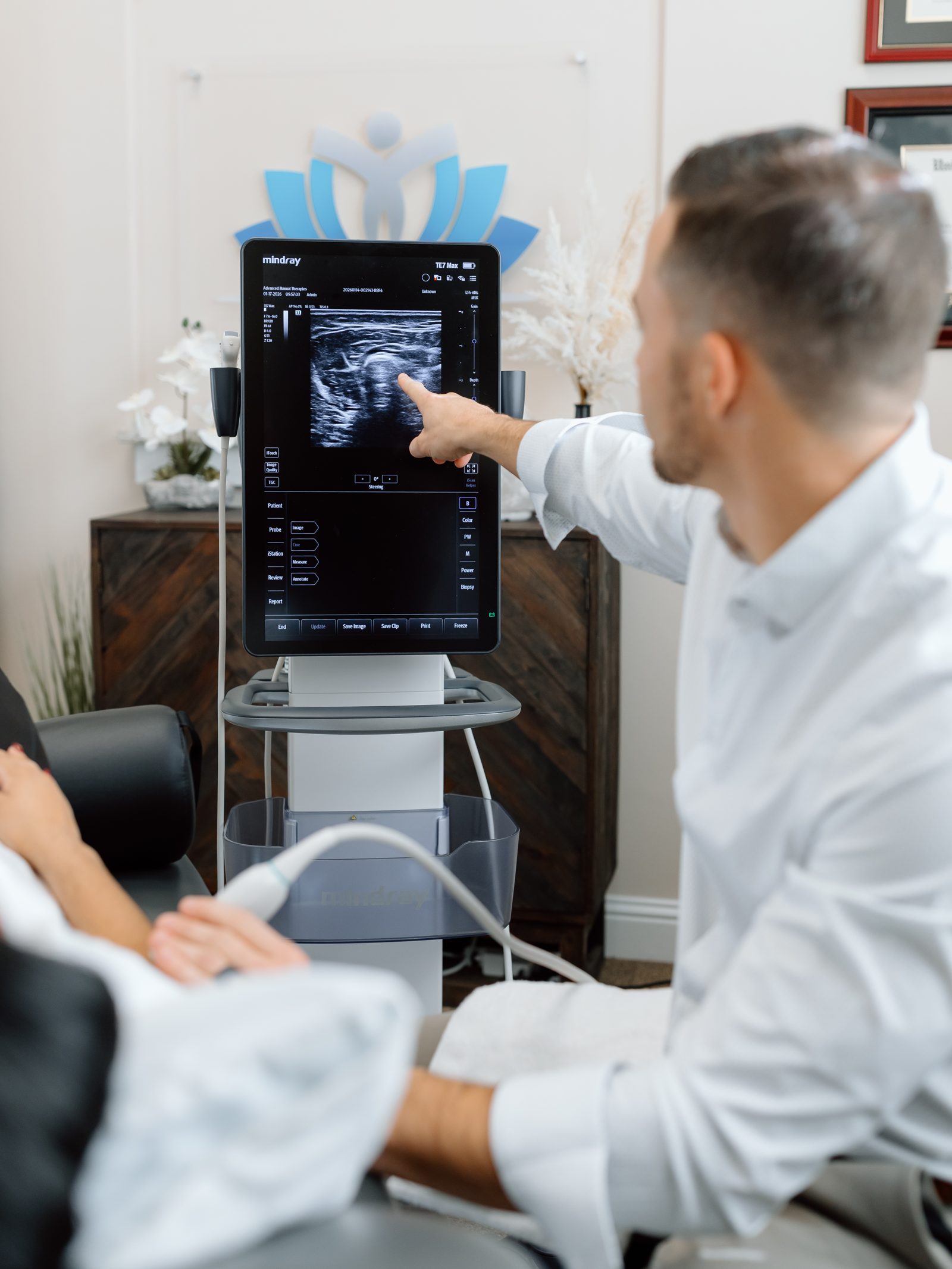
Course Overview
An advanced clinical course for licensed physical therapists expanding diagnostic musculoskeletal ultrasound skills into performance and longevity medicine. Covers tissue health assessment, guided injection preparation, tendinopathy grading, fascial assessment, and sarcopenia screening, with a hands-on scanning laboratory component and documentation guidance.
Learning Outcomes
After completing TWI 204: Musculoskeletal Ultrasound, you will be able to:
- Explain the physics of ultrasound–tissue interaction — acoustic impedance, reflection, refraction, attenuation, the three resolution axes, and anisotropy — and identify the artifact each creates on a musculoskeletal image.
- Describe the standard operator workflow for an MSK ultrasound examination — probe selection, presets, depth, focus, gain, and time-gain compensation — and predict how each control changes the image.
- Recognize the normal sonographic appearance of tendon, ligament, muscle, nerve, bone surface, hyaline cartilage, and joint capsule, and apply the four-part diagnostic-finding framework.
- Interpret a musculoskeletal ultrasound report of the shoulder, elbow, wrist, hip, knee, ankle, or peripheral nerve using anatomy-first vocabulary.
- Correlate sonographic findings with the patient's presentation, examination findings, and functional limitations to design a rehabilitation plan consistent with the imaging.
- Identify the sonographic red flags that require immediate coordination of care with the ordering or interpreting physician.
- Understand the DPT/DC role in MSK ultrasound imaging, defined once and clearly in Module 8.
- Integrate MSK ultrasound reporting into a longitudinal rehab plan and build a structured referral relationship with a credentialed imaging clinician.
Curriculum
1
Ultrasound Physics, Machine Operation & Image Optimization
2
Systematic Scanning Approach & Normal Tissue Sonoanatomy
3
Shoulder & Upper Arm Ultrasound
4
Elbow, Wrist & Hand Ultrasound
5
Hip & Thigh Ultrasound
6
Knee & Lower Leg Ultrasound
7
Ankle, Foot & Peripheral Nerve Ultrasound
8
Documentation, Scope of Practice & Referral Decision-Making